
Law revision · A level, BTEC and T Level
Everything for your law exam, in one app.
Learn the law. Argue well.
Every topic on your course in plain English, with leading cases, worked examples and exam tips. Then practise, get your written answers marked, and argue it out against an AI.
Choose your course to see what Veritas covers on it.
Set work your students will actually do.
Veritas Educators is a website for law teachers. Set reading, practice and exam questions from the same topics your students revise from, mark them with AI help, and see who needs a nudge before the mock.
We check every enquiry by hand, then get in touch to set you up. Free teaching resources
Matched to your specification
For educators
Veritas Educators
A website for law teachers. Set work from the same topics and questions your students revise from, mark it with AI help, and see who needs a nudge before the mock.
Tell us about your college and your classes. We check every enquiry by hand, then get in touch to set you up.
How it works
Three steps, every topic
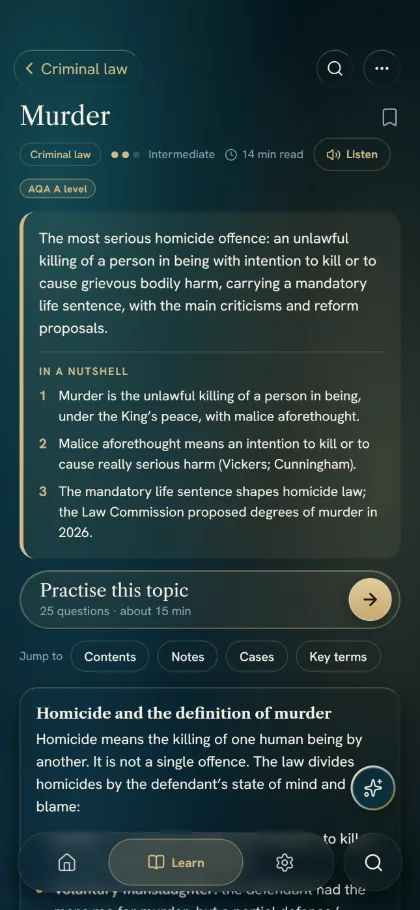
Read it
The topic in plain English, with the cases and a worked example. Short enough for the bus.
Test yourself
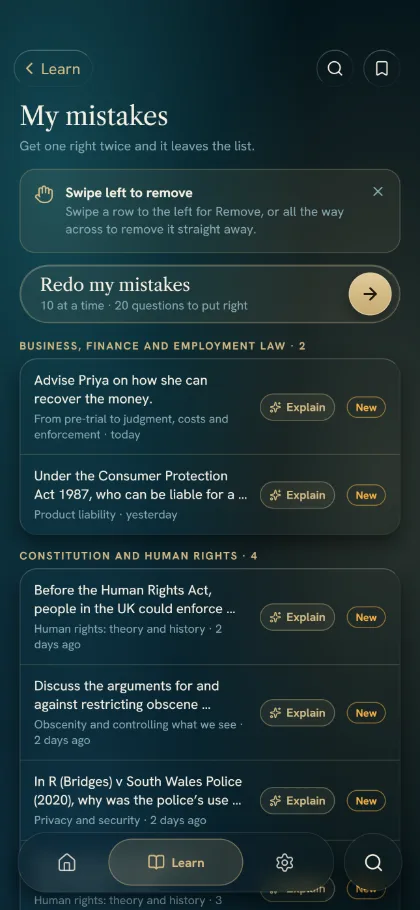
Quick questions straight after. The ones you get wrong come back until they stick.
Write and get marked
Answer an exam-style question and see which mark points you made, then improve it.
Try it now
Answer a real question from the app
No sign-up. Pick an answer to see if you're right, and why.
Loading a question…
The library
Every topic, by area of law
Open any topic for a summary, its key cases and key terms. 583 cases and 693 key terms have their own pages too.
- Analysing the business environment: SWOT and STEEPLE
- Business basics: purpose, aims and priorities
- Business models and organisational structures
- Consumer law and consumer credit for businesses
- Corporate governance and the Companies Act 2006
- Drivers for change and globalisation
- Intellectual property, standards and corporate crime
- Making business decisions
- The government and the economy
- The role of business in society
- UK tax and how it is applied
- Workplace law: health and safety and employment rights
- Acas, employment tribunals and criminal liability
- Advice, funding and ADR in civil cases
- Bank accounts, payment systems and consumer credit
- Business finance, lending and security
- Business-to-business sales and services
- Civil appeals
- Contracts of employment and their terms
- Corporate insolvency: CVAs, administration and liquidation
- Directors, company records and shareholder protection
- Discrimination in employment
- Drafting letters, file notes and court forms
- Employees, workers and the self-employed
- Forming a business: partnerships, LLPs and companies
- From pre-trial to judgment, costs and enforcement
- Negligent misstatement and vicarious liability
- Partnership law and agency
- Personal insolvency: IVAs, DROs and bankruptcy
- Product liability
- Searching legal databases and citing sources
- Termination, unfair dismissal and wrongful dismissal
- The track system and taking a claim to court
- Defamation: protecting reputation
- Human rights: theory and history
- Judicial review
- Life, liberty and a fair trial: Articles 2, 5 and 6
- Obscenity and controlling what we see
- Parliamentary sovereignty and its limits
- Privacy and security
- Protest and free speech
- The Human Rights Act 1998
- The UK constitution and the rule of law
- Trespass and harassment
- Breach and remedies
- Consideration and promissory estoppel
- Consumer rights: goods
- Consumer rights: services, digital content and online shopping
- Contract terms and exclusion clauses
- Discharge of a contract
- Economic duress
- Exclusion clauses: UCTA 1977 and the Consumer Rights Act 2015
- Intention to create legal relations
- Misrepresentation
- Offer and acceptance
- Privity and capacity
- Unfair trading, aggressive selling and consumer help
- Allocation, summary trial and trial on indictment
- Antisocial behaviour and discrimination in housing
- Bail and remand
- Criminal appeals
- Criminal damage and arson
- Criminal procedure: rules, victims, witnesses and disclosure
- Debt advice: options for people in debt
- Drafting court forms, client letters and other documents
- Funding and advice in criminal and welfare cases
- Homelessness law
- Identification procedures and the Turnbull guidelines
- Public order and regulatory offences
- Renting from a council or housing association
- Renting from a private landlord
- Searches and samples in police custody
- Sentencing
- The decision to prosecute: the CPS and private prosecutions
- Welfare benefits, housing agencies and debt services
- Actual bodily harm (section 47)
- Actus reus and mens rea
- Assault and battery (common assault)
- Attempts
- Automatism
- Burden and standard of proof
- Burglary (section 9)
- Causation
- Consent
- Corporate manslaughter
- Diminished responsibility
- Duress and necessity
- Fraud by false representation
- Gross negligence manslaughter
- Insanity
- Intention and recklessness
- Intoxication
- Loss of control
- Murder
- Omissions
- Robbery (section 8)
- Self-defence
- Strict liability offences
- The theory of criminal law
- Theft (sections 1–6 Theft Act 1968)
- Unlawful act manslaughter
- Wounding and GBH (sections 20 and 18)
- Analysing and presenting financial data
- Analytics, reporting and research methods
- Automation, AI and the changing workplace
- Cyber threats and their impact
- Data architecture and data governance
- Data management and data protection law
- Digital tools and digital transformation
- Keeping data secure
- Management information, Big Data and design thinking
- Managing risk
- Online courts and case management systems
- Threats to compliance and fraud prevention
- Billable hours, fixed fees, pro bono and legal aid
- Business planning for a legal practice
- Calculating profit, margins and net current assets
- Client money and the SRA Accounts Rules
- Depreciation: straight-line and reducing balance
- Financial statements and key terms
- Sources of finance
- Why finance matters: records, cash flow and audits
- Corporate responsibility: ESG and CSR
- Equality, diversity and inclusion
- Ethical dilemmas, business risk and professional scepticism
- Global events and financial crises
- Legal and financial regulators
- Legal professional privilege
- Money laundering and terrorist financing
- Professional and ethical conduct
- Regulated services, advice and mis-selling
- Regulatory change in legal services
- Business cases, the project triangle and the project life cycle
- Drivers of change in legal services
- Leading change and overcoming barriers
- Legal research and citation
- Presenting research
- Project tools, teams and responsibilities
- Research sources, ethics and reliability
- The research process and SMART objectives
- Access to justice and legal aid
- Civil courts and ADR
- Civil procedure: from letter before claim to costs
- Delegated legislation
- How Parliament makes law
- Judicial precedent
- Juries
- Law and justice
- Law and morality
- Law and society
- Law making in Wales: the Senedd and devolution
- Law reform and the Law Commission
- Legal professionals and judges
- Magistrates and the criminal courts
- Statutory interpretation
- The English legal system and the courts
- The European Union and EU law
- Tribunals
- Damages in negligence
- Defences and compensation in tort
- Negligence: breach of duty
- Negligence: causation and remoteness
- Negligence: duty of care
- Negligence: psychiatric injury
- Negligence: pure economic loss
- Occupiers' liability: trespassers (1984 Act)
- Occupiers' liability: visitors (1957 Act)
- Private nuisance
- Public nuisance and trespass to land
- The aims and theory of tort law
- The rule in Rylands v Fletcher
- Vicarious liability
What's inside
Everything your exam asks for, in one place
Read it, test yourself on it, write about it, argue about it. Each part of Veritas feeds the next.
Learn
Every topic, the way your exam wants it
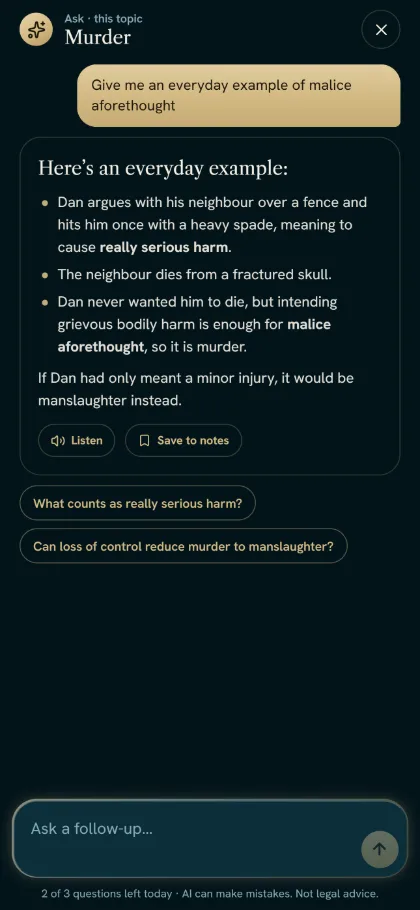
The law step by step, with the leading cases, strengths and weaknesses, a worked example and exam tips. Stuck? Ask about the topic and get it explained another way.
- Cases with the facts, the decision and why it matters
- Key terms you can tap from anywhere
- Ask about a topic to have it explained another way
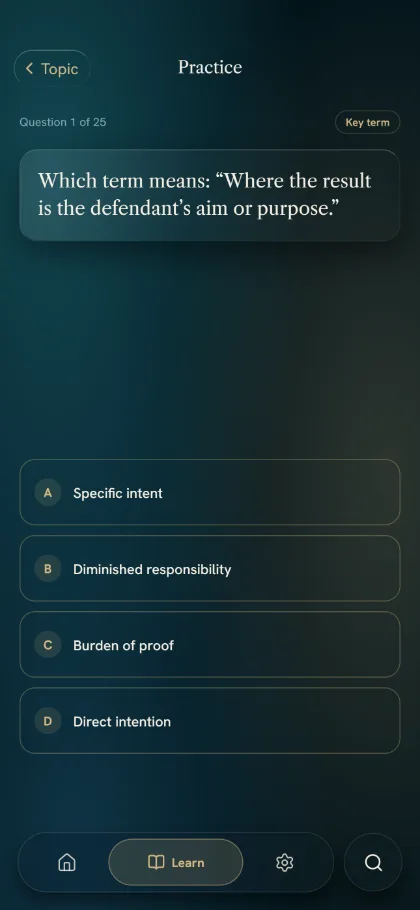
Practise and get marked
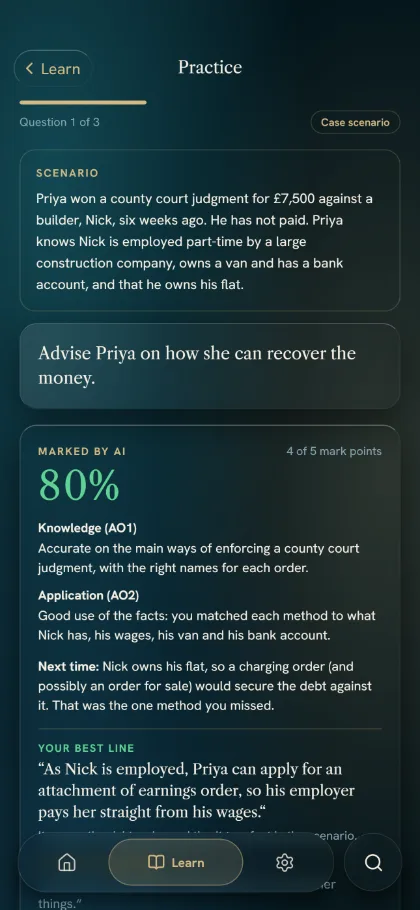
Write an answer. See which mark points you hit.
Quick questions for every topic, and written questions marked by AI against the mark points. You see what went well and what to add next time, then you can improve it.
- Problem questions, essays and definitions, like the real exam
- A mark, the mark points you made, what went well and what to add
- Improve your answer and have it marked again (Premium)
AI can make mistakes, so treat its mark as practice, not an official grade.
Plan
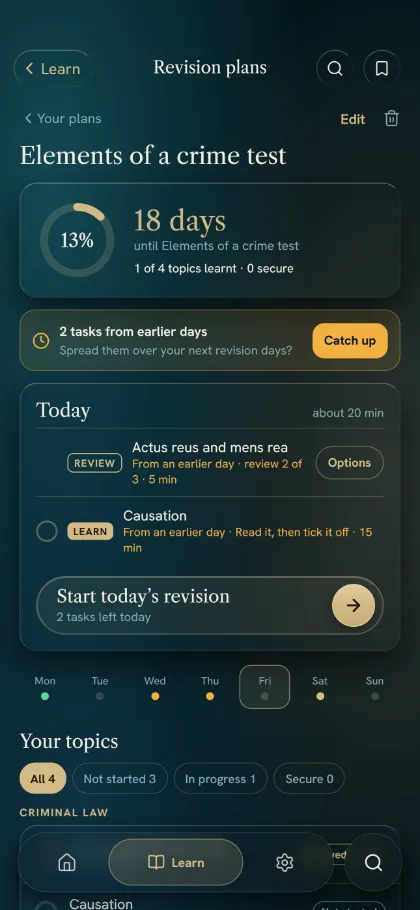
A revision plan to your exam date
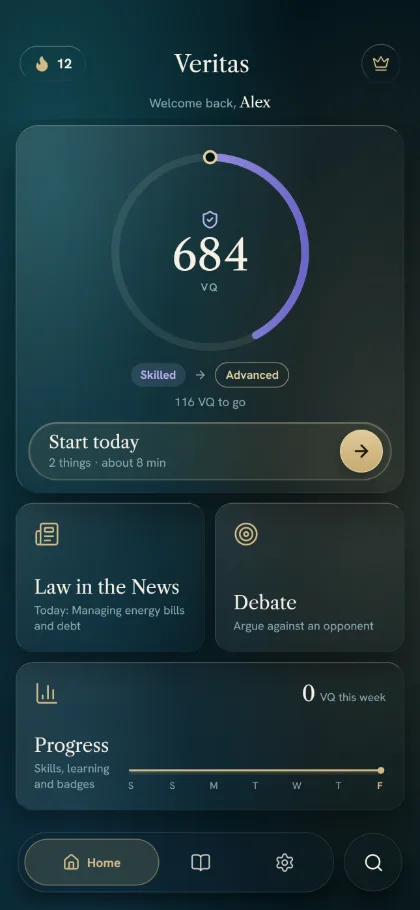
Choose your exam and topics. Veritas spreads them out and brings each one back for review before you forget it. It catches you up if you miss a day.
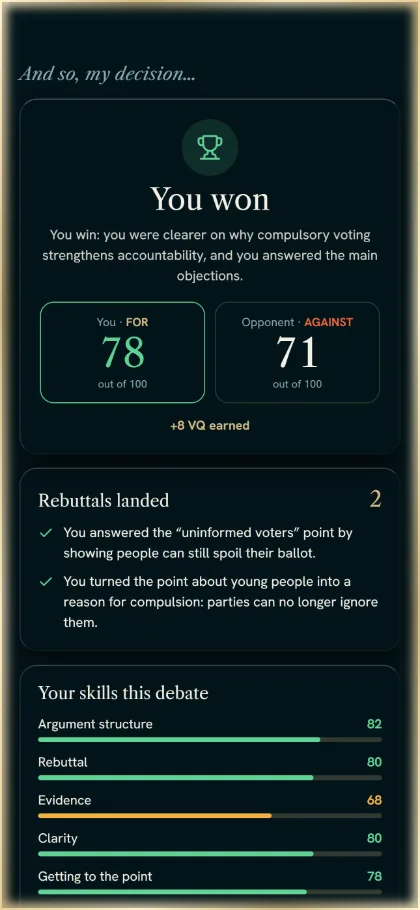
Debate
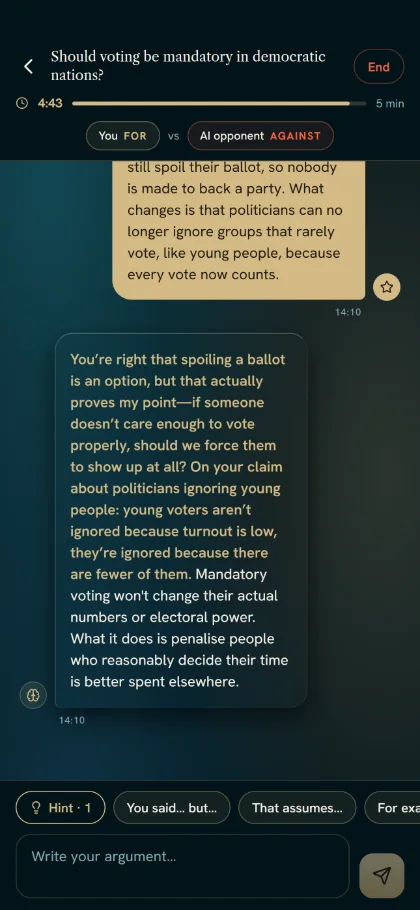
Argue a motion against an AI
Pick a side on one of 110 motions and argue it out. A judge sums up both sides and picks a winner. Law in the News gives you a real story to practise on every day.
Made for every brain
Read it the way that works for you
Reading fonts, colour overlays, line focus and read-aloud, on every topic. Some people with dyslexia or ADHD find these help.
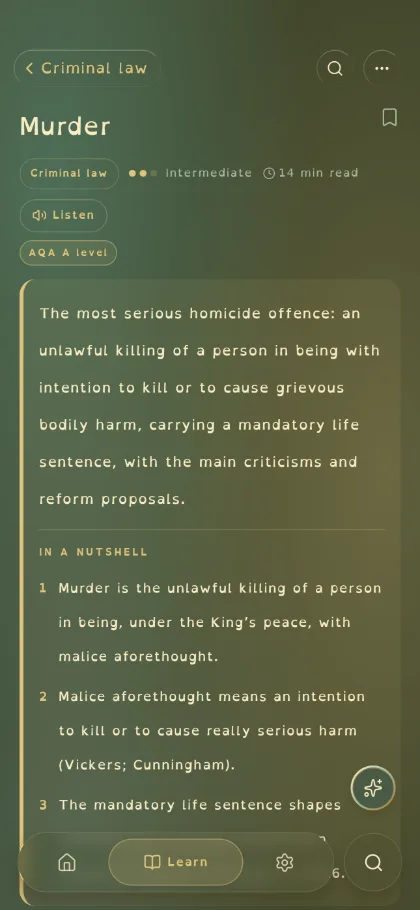
Fonts and overlays
OpenDyslexic, Lexend and Atkinson Hyperlegible, with tinted overlays.
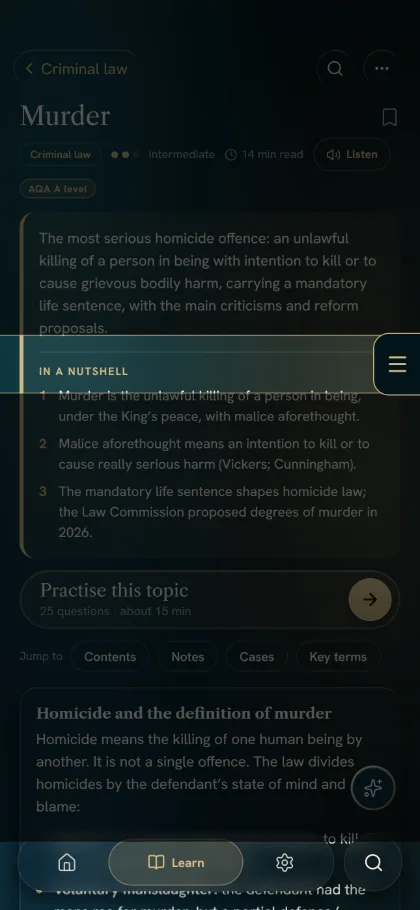
Line focus
Dims everything except the lines you're reading.
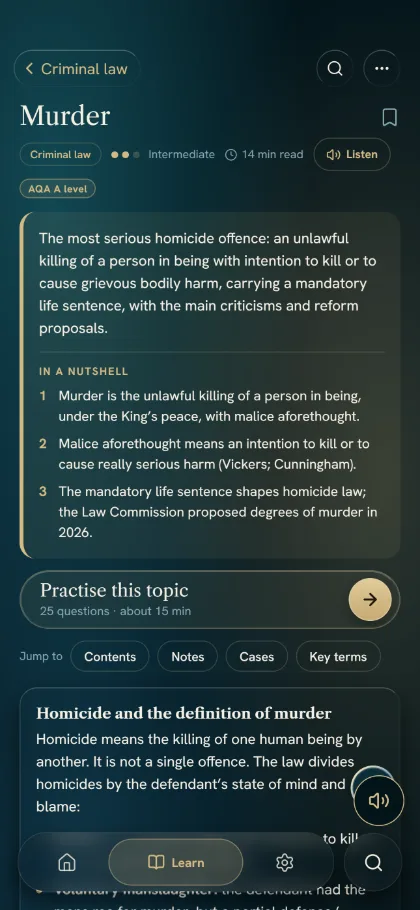
Read aloud
Listen to any topic while you follow along.
Where you can use it
On your iPhone, or in any browser
iPhone
The Veritas app
Everything in Veritas, free to download. Your progress syncs to your account.
App StoreLaptop
Veritas on the web
For anyone, with a free account. Opens in your browser, or install it as its own app in Chrome or Edge.
Open Veritas on the webAndroid
Add it to your home screen
For anyone, with a free account. Open it in Chrome, then choose Add to Home screen.
Open on AndroidWhat's new
The latest update
- Class insightsSee the topics your class finds hardest, anonymously. You choose what you share.
- Better reportsTopic scores and skills in your weekly report, and a class challenge report to share.
- Questions and answersWhere the content comes from, how the AI is used and how your data is kept, in Settings.
- Clearer free PremiumReminders before it ends, and it never charges you: it simply ends.
Questions
Before you start
Is Veritas really free?
Yes. Every topic, case, key term and practice question is free, with some AI marking and debate time each day. Premium (£4.99 a month or £39.99 a year) adds more AI, mock exams and revision plans. Nothing is charged unless you choose a plan, and you can cancel any time.
Which courses does it cover?
AQA, OCR, Eduqas and WJEC A level Law, the Pearson BTEC National in Applied Law and the Pearson T Level in Legal Services. Choose your course in the app and Veritas shows the topics on your specification.
Is the AI marking accurate?
It marks your answer against the mark points for the question and shows which ones you made, with what went well and what to add. It is a good guide for practice, but AI can make mistakes, so it is not an official grade. Your teacher and the exam board decide your real marks.
Does it work without an iPhone?
Yes. The app is on iPhone, and anyone can also use Veritas in a web browser at app.veritasdebate.app, on a laptop or an Android phone. On the web you need a free Veritas account, so your progress is saved and carries on in the iPhone app.
What can my teacher see?
Only if you join your teacher's class with their invite code: your progress on your course, your revision time from when you joined, and your answers to work they set. Your debates, Mentor chats, notes and email stay private. Before you join, the app shows you exactly what they'll see.
Is it legal advice?
No. Veritas explains the law of England and Wales for learning. It is general information, not advice about your own situation.
For parents and carers
What your child gets
What your child gets, what it costs, and what we do with their data.
Free, with an optional upgrade
All the learning is free. Premium is £4.99 a month or £39.99 a year, through the App Store, and it never starts by itself.
No ads, no tracking
There are no adverts, no social feeds and no chats with strangers. Progress stays on the phone unless your child creates an account.
Matched to their course
Topics follow the exam board specification for A level, BTEC and T Level Law.
Their teacher can use it too
With Veritas Educators, a teacher can set work and see progress, only once your child joins their class.
Private by design
No ads and no tracking. Your progress stays on your phone unless you create an account, and you can delete it any time.